
Study in the US
- REGION
- North America
- LANGUAGE
- English
- CURRENCY
- USD ($)
- TIME ZONES
- UTC−5 to UTC−10
- CLIMATE
- Temperate to tropical
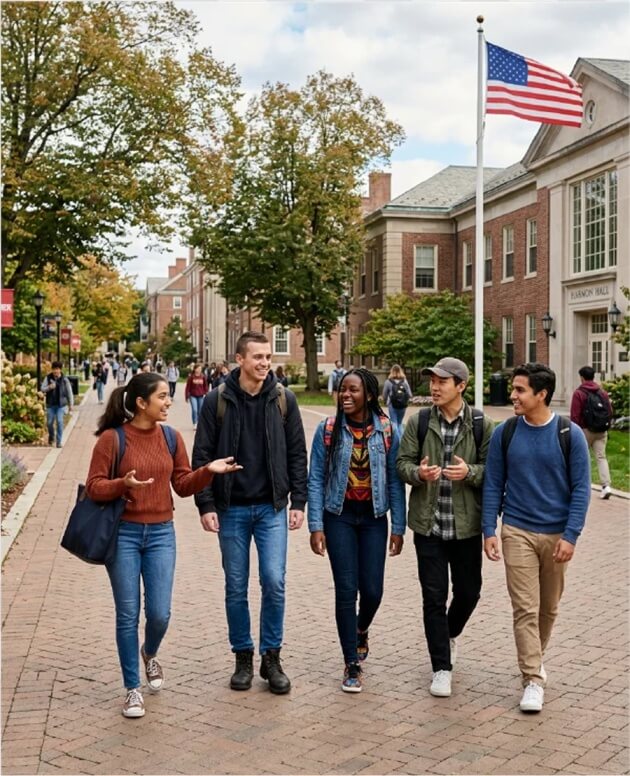
In the United States, international learners and professionals are immersed in dynamic English‑language environments. Academic programs emphasize discussion, collaboration, and hands‑on learning, supported by services such as tutoring and advising, while professionals apply English skills in real‑world contexts including workplace, clinical, and legal settings.
Outside of the workplace and classroom, life in the United States is vibrant and community‑oriented. Many people engage in clubs, sports, cultural events, and leadership activities, making it easy to build connections and feel a sense of belonging. For students, universities often offer on‑campus housing and dining options that provide both convenience and a strong sense of community.
Everyday life in the United States is shaped by practical considerations such as safety, transportation, and cost of living. Universities and organizations often provide dedicated safety resources, while transportation options vary by city or region. Planning for living expenses—including housing, food, and transportation—can help both students and professionals prepare for daily life and feel more settled as they adjust to their new environment.
Individuals come to the U.S. for a variety of purposes, including academic study, professional licensure, training, exchange programs, and employment. Requirements vary by pathway and organization, but English proficiency is often a shared prerequisite.
Because processes differ by purpose and visa type, these resources provide authoritative guidance on studying, working, or participating in exchange programs in the U.S.:
Visa and immigration information for students and exchange visitors
U.S. BUREAU OF CONSULAR AFFAIRS
Visa categories and the U.S. visa application process
EDUCATION USA (U.S. DEPARTMENT OF STATE)
Guidance on academic programs and study options in the United States
STUDY IN THE USA / INTERNATIONAL STUDENT USA
Overviews of programs, pathways, and life in the U.S.
We measure the real academic skills universities expect — listening, speaking, reading and writing, in the way they’re actually used in classrooms, lectures and coursework. Built on decades of research and trusted worldwide, TOEFL iBT® scores gives students the confidence to pursue opportunities anywhere.
One voice. Many accents. One global standard.
Frequently Asked Questions
With thousands of institutions in the U.S., it helps to start by identifying what matters most to you—such as academic programs, location, campus size, cost, and career outcomes. Many students use online college search tools and speak with advisors, ELL teachers, or agents for guidance. You should also confirm that any school you’re considering is properly accredited.
In the U.S., the terms are often used interchangeably. Generally, colleges focus on undergraduate education, while universities offer both undergraduate and graduate (master’s and doctoral) programs.
Undergraduate programs are the first level of university study after high school and lead to an associate or bachelor’s degree. Graduate programs follow a bachelor’s degree and lead to advanced qualifications such as a master’s or doctorate.
The academic year usually runs from late summer (August or September) through May, with breaks for holidays. Institutions may follow a semester system (two main terms), a quarter system (three terms per year), or a trimester system.
Most U.S. colleges and universities require students to have completed secondary education (high school or equivalent). While there is no strict upper age limit, students are typically at least 17 years old at the time they begin their studies.




This guide explains what international students can expect in American universities, including active class participation, accessible professors, critical thinking and more.

Discover the benefits of studying in the USA for international students.
Discover the minimum TOEFL score requirements for universities in the USA, UK, and Canada.

Dreaming of studying abroad? Discover everything you need to know about studying in the U.S., U.K., or Europe.

Everyone talks about how great it is to speak a second language, but did you know it actually benefits your brain? We’re deep diving into the benefits and how learning a second language can rewire your thinking.

Preparing for your TOEFL test? Use these study tips to get the most out of your sessions and avoid burnout.

Explore student life in Canada, Germany, and Australia — from campus culture to lifestyle, food, and adventures outside the classroom.
Think you need a native accent or perfect grammar to ace the TOEFL iBT®? Think again. Discover the 5 biggest myths about English proficiency tests—and what actually matters.
U.S. Department of State network
University search & guides
Community & resources